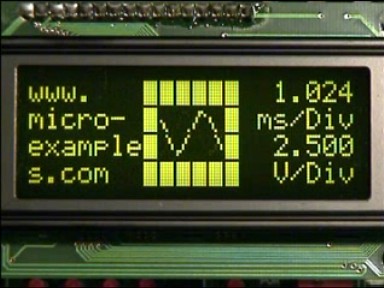
How to build a simple and low-cost oscilloscope with a text LCD?
Overview
LCDscope uses custom characters on a text LCD to build a tiny graphic screen for a mini oscilloscope. Works with both 4x20 and 2x16 text LCDs.
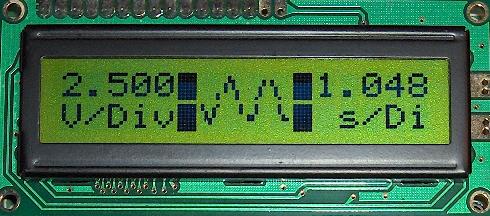
LCDscope on a 2x16 LCD
Circuit Schematic
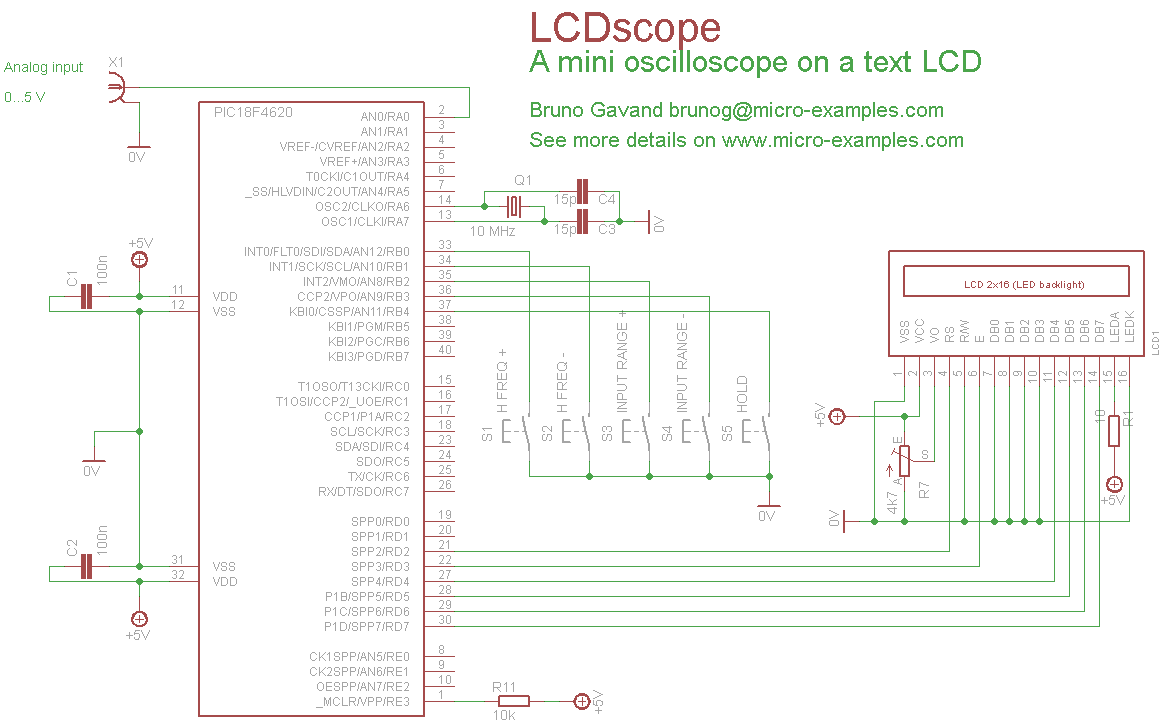
LCDscope circuit schematic
- LCD1 is a 4x20 text LCD (also works with 2x16).
- Input signal is 0-5V.
How it works
LCDscope uses a miniGLCD pseudo-graphic library with functions: miniGLCD_fill, miniGLCD_setPixel, miniGLCD_line, miniGLCD_getPixel. Uses Bresenham's line drawing algorithm.
ISR handles Timer0 for ADC sampling with trigger detection. PORTB buttons for frequency/range/hold control.
Pin assignment:
- RA0: analog input
- RB0-RB4: buttons
- RD2-RD7: LCD 4-bit mode
C Source Code
LCDscope.c
/* ******************************************************************************* * LCDscope : a PIC18 oscilloscope on a 20x4 text LCD * also works with a standard 16x4 text LCD ******************************************************************************* * * This program shows how to use custom chars on a text LCD to build a tiny * graphic screen. To illustrate this, here is a quick & dirty mini oscilloscope. * * source code for mikro C compiler V8.2 * feel free to use this code at your own risks * * target : PIC18 with 10 Mhz crystal, HS PLL * * PIC PIN Assignment : * * RA0 : analog input, 0-5V * * control buttons on PORTB (internal pull-ups, switchs to GND) : * RB0/RB1 : change horizontal frequency * RB2/RB3 : change input range * RB4 : hold/release screen * * 4-bit LCD on PORTD : * RD2 : RS * RD3 : E * RD4 : D4 * RD5 : D5 * RD6 : D6 * RD7 : D7 * Note : R/W pin of LCD must be tied to ground. * ******************************************************************************* */ /********************* * CONSTANTS *********************/ // if you have a 16x2 standard LCD, untag this line : //#define LCD16x2 // otherwise, you are supposed to have the nice 20x4 LCD #ifndef LCD16x2 #define LCD20x4 #endif #define C_X 4 // number of columns in pseudo-graphic screen #define C_Y 2 // number of rows in pseudo-graphic screen #define miniGLCD_x (5*C_X) // number of X pixels in pseudo-graphic screen #define miniGLCD_y (8*C_Y) // number of Y pixels in pseudo-graphic screen #define LEVEL 16 // trigger sensitivity (number of ADC points) // colors of pseudo-graphic screen #define miniGLCD_COLOR_WHITE 0 #define miniGLCD_COLOR_BLACK 1 #define miniGLCD_COLOR_REVERSE 2 // pseudo-graphic function prototypes void miniGLCD_fill(unsigned char c) ; void miniGLCD_setPixel(char x, char y, unsigned char mode) ; void miniGLCD_line(char x0, char y0, char x1, char y1, unsigned char pcolor) ; unsigned char miniGLCD_getPixel(char x, char y) ; /*************** * RAM VARIABLES ***************/ // horizontal frequency structure struct TIMEBASE { unsigned char t0con ; unsigned char period[8] ; unsigned char unit ; } timeBase[] = { { 0b10000100, "1.04857", ' ' }, { 0b10000011, "524.288", 'm' }, { 0b10000010, "262.144", 'm' }, { 0b10000001, "131.072", 'm' }, { 0b10000000, "65.536 ", 'm' }, { 0b11000111, "32.768 ", 'm' }, { 0b11000110, "16.384 ", 'm' }, { 0b11000101, "8.192 ", 'm' }, { 0b11000100, "4.096 ", 'm' }, { 0b11000011, "2.048 ", 'm' }, { 0b11000010, "1.024 ", 'm' }, { 0b11000001, "512 ", '\xe4' }, { 0b11000000, "256 ", '\xe4' }, { 0b11001000, "128 ", '\xe4' } } ; unsigned char tbase = 0 ; // vertical input range structure struct INPUT { unsigned char div ; unsigned char *ampl ; } input[] = { { 4, "2.500" }, { 2, "1.250" }, { 1, "0.625" }, } ; unsigned char ipt = 0 ; unsigned char vdiv ; #ifdef LCD20x4 // scrolling message unsigned char msg[][8] = { " ", " ", " ", " ", " LCD ", " SCOPE ", " By ", "BrunoG ", "* ", " ", " ", " see ", " more ", "details", " and ", "dwnload", "mikroC ", "source ", "code on", " ", "www. ", "micro- ", "example", "s.com ", "* ", "" } ; unsigned char firstMsg = 0 ; #endif unsigned char miniGLCD_screen[C_X * C_Y * 8] ; // pseudo-screen bitmap unsigned char samples[miniGLCD_x] ; // sample table unsigned char sIdx = 0 ; // sample index unsigned char trigger = 0 ; // trigger status unsigned char trigValue = 0 ; // trigger value unsigned char hold = 0 ; // hold screen flag unsigned int t0ctr ; // timer 0 overflow counter /**************************** * INTERRUPT ROUTINE ****************************/ void interrupt() { if(INTCON.TMR0IF) { if(sIdx < miniGLCD_x) // sampling in progress? { if(trigger == 2) // sampling triggered? { samples[sIdx++] = miniGLCD_y - (ADRESH >> vdiv) ; } else if(trigger == 1) // maximum detected { if((trigValue > LEVEL) && (ADRESH < trigValue - LEVEL)) { trigger = 2 ; } else { if(ADRESH > trigValue) { trigValue = ADRESH ; } } } else // looking for maximum { if((trigValue < 255 - LEVEL) && (ADRESH > trigValue + LEVEL)) { trigger = 1 ; trigValue = 0 ; } else { if(ADRESH < trigValue) { trigValue = ADRESH ; } } } ADCON0.GO = 1 ; // start ADC } t0ctr++ ; INTCON.TMR0IF = 0 ; } } /******************************* * UPDATE SETTINGS & DRAW SCREEN *******************************/ void mkScreen() { T0CON = timeBase[tbase].t0con ; vdiv = input[ipt].div ; ADCON1 = 0b00001110 ; ADCON0 = 0b11000001 ; #ifdef LCD20x4 LCD_out(1, 14, timeBase[tbase].period) ; LCD_chr(2, 15, timeBase[tbase].unit) ; LCD_out(3, 16, input[ipt].ampl) ; LCD_out(1, 9, hold ? "Hold" : "\xff\xff\xff\xff") ; #else LCD_out(1, 12, timeBase[tbase].period) ; LCD_chr(2, 12, timeBase[tbase].unit) ; LCD_out(1, 1, input[ipt].ampl) ; LCD_out(1, 6, hold ? "H" : "\xff") ; #endif } /************************ * DEBOUNCE PORTB KEYS ************************/ void debounce() { mkScreen() ; Delay_ms(20) ; while(PORTB != 0xff) ; Delay_ms(20) ; } /*********************** * PSEUDO GRAPHIC FUNCTIONS ***********************/ void miniGLCD_fill(unsigned char c) { memset(miniGLCD_screen, c, sizeof(miniGLCD_screen)) ; } void miniGLCD_setPixel(char x, char y, unsigned char mode) { unsigned char *ptr ; unsigned char mask ; if(x < 0) return ; if(y < 0) return ; if(x > miniGLCD_x) return ; if(y > miniGLCD_y) return ; ptr = miniGLCD_screen + (((y * (C_X * 8)) + x) / 8) ; mask = 1 << (x & 7) ; switch(mode) { case miniGLCD_COLOR_BLACK: *ptr &= ~mask ; break ; case miniGLCD_COLOR_WHITE: *ptr |= mask ; break ; default: *ptr ^= mask ; break ; } } unsigned char miniGLCD_getPixel(char x, char y) { unsigned char *ptr ; unsigned char mask ; if(x < 0) return(0) ; if(y < 0) return(0) ; if(x > miniGLCD_x) return(0) ; if(y > miniGLCD_y) return(0) ; ptr = miniGLCD_screen + (((y * (C_X * 8)) + x) / 8) ; mask = 1 << (x & 7) ; return(*ptr & mask) ; } /* * miniGLCD_line : Bresenham's line drawing algorithm */ void miniGLCD_line(char x0, char y0, char x1, char y1, unsigned char pcolor) { int dy ; int dx ; int stepx, stepy ; dy = y1 - y0 ; dx = x1 - x0 ; if(dy < 0) { dy = -dy ; stepy = -1 ; } else { stepy = 1 ; } if(dx < 0) { dx = -dx ; stepx = -1 ; } else { stepx = 1 ; } dy <<= 1 ; dx <<= 1 ; miniGLCD_setPixel(x0, y0, pcolor) ; if(dx > dy) { int fraction = dy - (dx >> 1) ; while(x0 != x1) { if(fraction >= 0) { y0 += stepy ; fraction -= dx ; } x0 += stepx ; fraction += dy ; miniGLCD_setPixel(x0, y0, pcolor) ; } } else { int fraction = dx - (dy >> 1) ; while(y0 != y1) { if(fraction >= 0) { x0 += stepx ; fraction -= dy ; } y0 += stepy ; fraction += dx ; miniGLCD_setPixel(x0, y0, pcolor) ; } } } /* * program custom character n at line pos_row column pos_char */ void CustomChar(unsigned char mode, unsigned char n, char pos_row, char pos_char) { unsigned char i, j ; LCD_Cmd(64 + n * 8) ; for(i = 0 ; i < 8 ; i++) { unsigned char bm = 0 ; for(j = 0 ; j < 5 ; j++) { bm <<= 1 ; bm |= miniGLCD_getPixel(pos_char * 5 + j, pos_row * 8 + i) ? 1 : 0 ; } LCD_Chr_Cp(bm) ; } LCD_Cmd(LCD_RETURN_HOME) ; #ifdef LCD20x4 if(mode) LCD_Chr(pos_row + 2, pos_char + 9, n) ; #else if(mode) LCD_Chr(pos_row + 1, pos_char + 7, n) ; #endif } /****************** * MAIN LOOP ******************/ void main() { unsigned char i, j ; unsigned int wait ; TRISA = 0xff ; // PORTA as inputs TRISB = 0xff ; // PORTB as inputs INTCON2.NOT_RBPU = 0 ; // enable PORTB pull-ups TRISD = 0 ; // PORTD is output (LCD) INTCON.TMR0IF = 0 ; INTCON.TMR0IE = 1 ; INTCON.GIE = 1 ; LCD_Init(&LATD) ; LCD_Cmd(Lcd_CLEAR) ; LCD_Cmd(Lcd_CURSOR_OFF) ; #ifdef LCD20x4 LCD_out(1, 8, "\xff\xff\xff\xff\xff\xff") ; LCD_out(2, 8, "\xff \xff s/Div") ; LCD_out(3, 8, "\xff \xff") ; LCD_out(4, 8, "\xff\xff\xff\xff\xff\xff V/Div") ; #else LCD_out(1, 1, " \xff \xff") ; LCD_out(2, 1, "V/Div\xff \xff s/Div") ; #endif // send custom chars CustomChar(1, 0, 0, 0) ; CustomChar(1, 1, 0, 1) ; CustomChar(1, 2, 0, 2) ; CustomChar(1, 3, 0, 3) ; CustomChar(1, 4, 1, 0) ; CustomChar(1, 5, 1, 1) ; CustomChar(1, 6, 1, 2) ; CustomChar(1, 7, 1, 3) ; mkScreen() ; for(;;) { if((hold == 0) && (sIdx == miniGLCD_x)) { miniGLCD_fill(0) ; // draw wave for(i = 0 ; i < miniGLCD_x - 1 ; i++) { j = i + 1 ; miniGLCD_line(i, samples[i], j, samples[j], miniGLCD_COLOR_WHITE) ; } // program custom chars CustomChar(0, 0, 0, 0) ; CustomChar(0, 1, 0, 1) ; CustomChar(0, 2, 0, 2) ; CustomChar(0, 3, 0, 3) ; CustomChar(0, 4, 1, 0) ; CustomChar(0, 5, 1, 1) ; CustomChar(0, 6, 1, 2) ; CustomChar(0, 7, 1, 3) ; trigValue = 255 ; trigger = 0 ; sIdx = 0 ; } // change horizontal frequency if(PORTB.F0 == 0) { tbase++ ; if(tbase == sizeof(timeBase) / sizeof(struct TIMEBASE)) { tbase = 0 ; } hold = 0 ; debounce() ; } else if(PORTB.F1 == 0) { if(tbase == 0) { tbase = sizeof(timeBase) / sizeof(struct TIMEBASE) - 1 ; } else { tbase-- ; } hold = 0 ; debounce() ; } // change vertical range else if(PORTB.F2 == 0) { ipt++ ; if(ipt == sizeof(input) / sizeof(struct INPUT)) { ipt = 0 ; } hold = 0 ; debounce() ; } else if(PORTB.F3 == 0) { if(ipt == 0) { ipt = sizeof(input) / sizeof(struct INPUT) - 1 ; } else { ipt-- ; } hold = 0 ; debounce() ; } // hold/release screen else if(PORTB.F4 == 0) { hold ^= 1 ; debounce() ; } #ifdef LCD20x4 // scrolling message if(wait) { if(t0ctr > (1u << (tbase + 5))) { firstMsg++ ; if(msg[firstMsg][0] == 0) { firstMsg = 0 ; } t0ctr = 0 ; wait = 0 ; } } else if(t0ctr > (1u << (tbase + 1))) { j = firstMsg ; for(i = 1 ; i <= 4 ; i++) { if((i == 4) && (msg[j + 1][0] == '*')) { wait++ ; } if(msg[j][0] == '*') { LCD_out(i, 1, " ") ; } else { LCD_out(i, 1, msg[j]) ; } j++ ; if(msg[j][0] == 0) { j = 0 ; } } firstMsg++ ; if(msg[firstMsg][0] == 0) { firstMsg = 0 ; } t0ctr = 0 ; } #endif } }
Download project
LCDscope project files
Download LCDscope-project.zip for mikroC PRO for PIC18F4620:
Includes:
- mikroC PRO project files for PIC18F4620
- Source code (~680 lines)
- HEX files