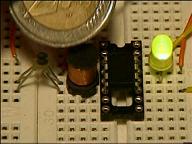
How to detect metal with a PIC and a few components?
Overview
A short video clip is sometimes better than a long explanation:
How it works
The idea of this circuit is to hack PIC oscillator circuit, by replacing the crystal by a coil: the frequency of the oscillator then depends on presence of metal near the coil, just like in a classic metal detector.
To detect changes of main oscillator frequency, we use the PIC watchdog as internal time reference.
By comparing both oscillators frequencies, we can know if a piece of metal is near the coil, and then light a LED.
It shares the same idea as PicoBat, the ultrasonic bat detector.
Circuit Schematic
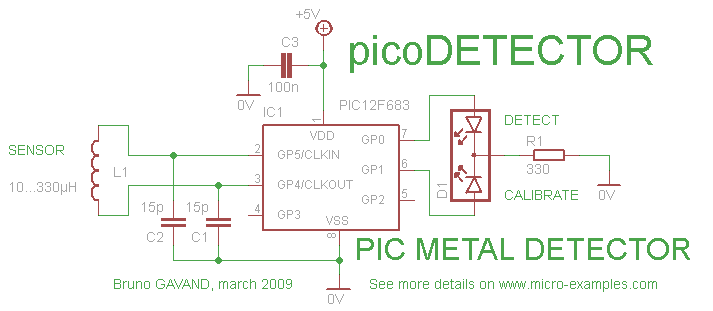
PicoDetector circuit schematic
- Coil L1 replaces crystal in PIC oscillator circuit: try with the coils you have to find the best one! If calibrate LED blinks on power up, it works.
- D1 is a dual color LED, replace with two classic LEDs if you don't have one.
C Source Code
picoDetector.c
/*
 *******************************************************************************
 * picoDetector : an ultra simple and cheap metal detector
 *******************************************************************************
 *
 * Author : Bruno Gavand, april 2009
 * see more details on http://www.micro-examples.com/
 *
 * source code for mikroC PRO compiler V1.65
 * feel free to use this code at your own risks
 *
 * target : PIC12, oscillator in HS mode, watchdog enabled
 *
 * PIC PIN Assignemnt :
 *
 * GP0 : detect LED indicator
 * GP1 : calibrate LED indicator
 * GP2 : NC
 * GP3 : NC
 * GP4, GP5 : inductor
 *
 *******************************************************************************
 */

#define MAXTRY 15       // number of watchdog restart to calibrate loop counter

unsigned char   ctr;            // number of loops between two watchdog resets
unsigned char   previous;       // previous value of ctr
unsigned char   calibr;         // calibration value when oscillator runs free
unsigned char   restarts;       // number of watchdog restarts
unsigned char   en;             // enable flag, allows detection

/*
 * main loop
 */
void    main()
        {
        unsigned char   i;

        /*
         * configure GPIO as digital port
         */
        CMCON0 = 7;
        ANSEL = 0;
        TRISIO = 0;
        GPIO = 0;

        /*
         * power up?
         */
        if(STATUS.NOT_TO)
                {
                /*
                 * yes, init variables
                 */
                restarts = 0;
                calibr = 1;
                }

        /*
         * watchdog reset counter
         */
        if(restarts < 255) restarts++;

        /*
         * if counter differs too much from calibration value
         */
        if((previous ^ ctr) > calibr)
                {
                /*
                 * turn detect LED on
                 */
                GPIO.F0 = en;

                /*
                 * if not on power up
                 */
                if(STATUS.NOT_TO == 0)
                        {
                        /*
                         * while in calibration mode
                         */
                        if(restarts < MAXTRY)
                                {
                                /*
                                 * shift calibration value
                                 * and wait a little bit
                                 */
                                calibr <<= 1;
                                Delay_ms(5);
                                }
                        }
                else
                        {
                        /*
                         * turn detect LED off
                         */
                        GPIO.F0 = 0;
                        }
                }

        /*
         * save last counter
         */
        previous = ctr;

        /*
         * is calibration over?
         */
        if(restarts > MAXTRY)
                {
                /*
                 * yes, turn calibrate LED off
                 * and set enable flag
                 */
                GPIO.F1 = 0;
                en = 1;
                }
        else
                {
                /*
                 * no, turn calibrate LED on
                 * and clear enable flag
                 */
                GPIO.F1 = 1;
                en = 0;
                }

        /*
         * set watchdog prescaler
         */
        OPTION_REG = 0b11111001;

        /*
         * start counter, to be interrupted by watchdog
         */
        ctr = 0;
        for(;;)
               {
               ctr++;
               }
        }
Download project
PicoDetector project files
Download picoDetector_project.ZIP file for mikroC:
Includes:
- mikroC PRO project files for PIC12F683, should work also with most PIC
- picoDetector C source code
- picoDetector .HEX files