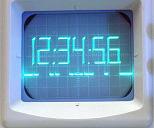
Your are proud of your expensive oscilloscope, now you can turn it into a cheap digital clock!
Overview
Your are proud of your expensive oscilloscope, now you can turn it into a cheap digital clock! Uses 2-bit R2R DAC for 4 voltage levels. Three frames per digit due to retinal persistence.
How to set up
Oscilloscope setup: timebase 0.1ms, 1V/div, external trigger. RA0 triggers oscilloscope vertical sync.
Circuit Schematic
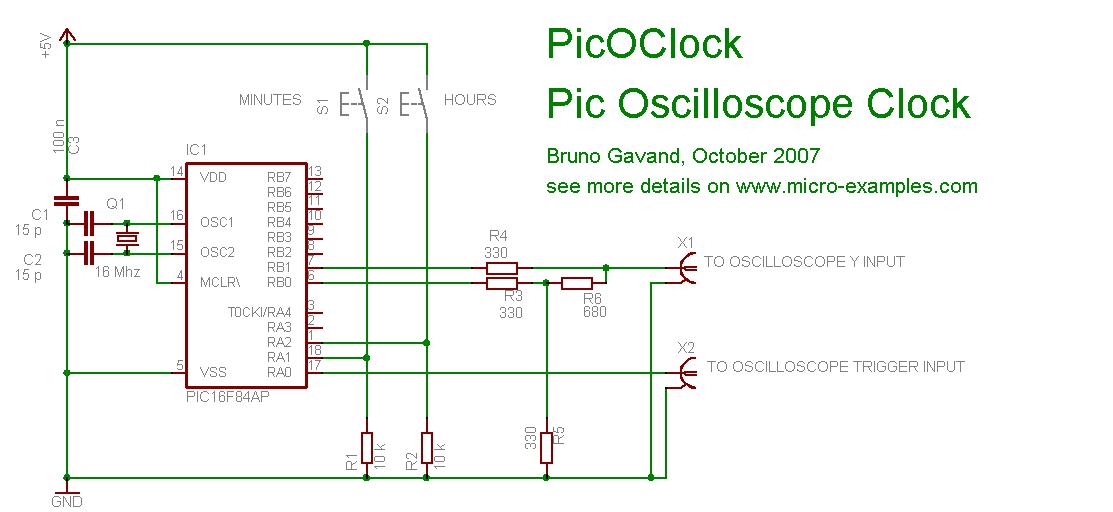
PicOClock circuit schematic
- 2-bit R2R DAC made by resistor ladder R3-R6 (680/330 ohms) driven by RB0/RB1.
- Tested with PIC16F84A and PIC16F877A.
Frame Rendering
Each digit is rendered across 3 frames (upper, middle, lower horizontal lines) using retinal persistence to display the full character.
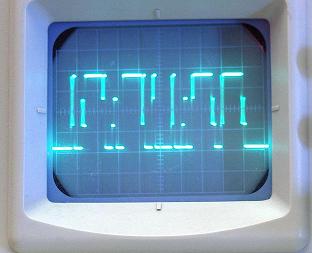
Frame 1 — upper horizontal lines
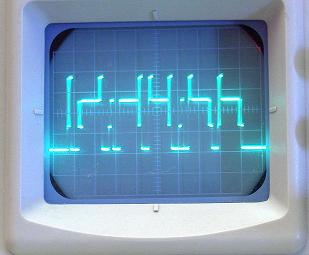
Frame 2 — middle horizontal lines
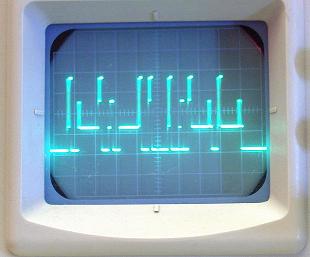
Frame 3 — lower horizontal lines
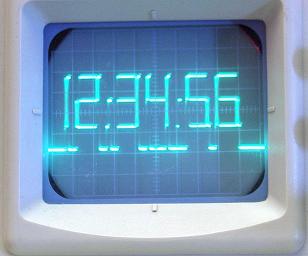
Frame 4 — combined result
C Source Code
picoClock.c
/* ******************************************************************************* * PICOCLOCK : PIC Oscilloscope CLOCK ******************************************************************************* * * This program shows how to display a digital clock on an oscilloscope * with a PIC and only 4 resistors. * * Circuit schematics : * * ------------+ * RA0 +----------------> to oscilloscope X trigger input * | * RA1 +----------------> pull-up, button to ground : minutes adjustment * RA2 +----------------> pull-up, button to ground : hours adjustment * PIC | ____ * RB1 +----|____|-----+----------> to oscilloscope Y input * | 680 | * | +-+ * | | | 330 * | +-+ * | ____ | * RB0 +----|____|-----+ * | 680 | * ------------+ +-+ * | | 680 * +-+ * | * ----- * --- GND * - * * Oscilloscope setup : * set timebase to 0.1 ms, V/div = 1 V * select external trigger. * * source code for mikro C compiler V7.0.0.3 * feel free to use this code at your own risks * * target : PIC16 or PIC18, 16 Mhz crystal * HS clock, no watchdog. * * tested with PIC16F84A and PIC16F877A * ******************************************************************************* */ #define TRIGGER PORTA.F0 // oscilloscope trigger output #define KEY PORTA & 0b110 // input keys mask #define KEY_MIN_UP PORTA & 0b010 // minute adjust button #define KEY_HH_UP PORTA & 0b100 // hour adjust button /* * 2 bits R2R DAC gives 4 output levels : */ #define HIGH PORTB = 0b11 // upper line #define MID PORTB = 0b10 // middle line #define LOW PORTB = 0b01 // lower line #define ZERO PORTB = 0b00 // lowest line #define MAX_SCALER 15625 // timer 0 overflows/sec @ 16 MHz #define MAX_DIGIT 6 // number of digits to display #define SLOTS (MAX_DIGIT * 3 + 4) // time slots: 2 header, 3/digit, 2 trailer /* * 10 digits 7 segment encoding + blank */ const unsigned char septSeg[11] = { 0x3f, 0x06, 0x5b, 0x4f, 0x66, 0x6d, 0x7d, 0x07, 0x7f, 0x6f, 0x00 } ; /* * slot index for digit start */ const unsigned char sIdx[] = {1, 4, 8, 11, 15, 18} ; unsigned char display[MAX_DIGIT] ; // digit to be displayed /* * time slot encoded line flags : * bit 0 is upper line * bit 1 is middle line * bit 2 is lower line * bit 6 is lower vertical bar * bit 7 is upper vertical bar */ unsigned char line[SLOTS] ; unsigned char dIdx = 0 ; // time slot counter unsigned char fIdx = 0 ; // frame counter unsigned int scaler = 0 ; // RTC scaler unsigned char ss = 0, mn = 0, hh = 0 ; // RTC void delay10us() { Delay_us(10) ; } /* * ISR */ void interrupt(void) { if(INTCON.T0IF) { scaler++ ; if(scaler > MAX_SCALER) { scaler = 0 ; ss++ ; if(ss == 60) { ss = 0 ; mn++ ; if(mn == 60) { mn = 0 ; hh++ ; if(hh == 24) { hh = 0 ; } } } } if(line[dIdx].F6 && line[dIdx].F7) // full vertical bar { LOW, HIGH, LOW, HIGH ; LOW, HIGH, LOW, HIGH ; LOW, HIGH, LOW, HIGH ; LOW, HIGH, LOW, HIGH ; LOW, HIGH, LOW, HIGH ; LOW, HIGH, LOW, HIGH ; LOW, HIGH, LOW, HIGH ; LOW, HIGH, LOW, HIGH ; } else if(line[dIdx].F6) // lower vertical bar { MID, LOW, MID, LOW ; MID, LOW, MID, LOW ; MID, LOW, MID, LOW ; MID, LOW, MID, LOW ; MID, LOW, MID, LOW ; MID, LOW, MID, LOW ; MID, LOW, MID, LOW ; MID, LOW, MID, LOW ; } else if(line[dIdx].F7) // upper vertical bar { MID, HIGH, MID, HIGH ; MID, HIGH, MID, HIGH ; MID, HIGH, MID, HIGH ; MID, HIGH, MID, HIGH ; MID, HIGH, MID, HIGH ; MID, HIGH, MID, HIGH ; MID, HIGH, MID, HIGH ; MID, HIGH, MID, HIGH ; } if(dIdx == 7) // hour:minute separator { LOW, Delay10us() ; MID, Delay10us() ; } else if(dIdx == 14) // minute:second separator { if(scaler < MAX_SCALER / 2) // blink 0.5 Hz { LOW, Delay10us() ; MID, Delay10us() ; } } switch(fIdx) { case 0: // upper line if(line[dIdx] & 1) { HIGH ; } else { ZERO ; } break ; case 1: // middle line if(line[dIdx] & 2) { MID ; } else { ZERO ; } break ; case 2: // lower line if(line[dIdx] & 4) { LOW ; } else { ZERO ; } break ; } dIdx++ ; if(dIdx == SLOTS) { dIdx = 0 ; TRIGGER = 1 ; // trigger the scope fIdx++ ; if(fIdx == 3) { fIdx = 0 ; } TRIGGER = 0 ; } INTCON.T0IF = 0 ; } } /* * main entry */ void main() { #ifdef P16F877A ADCON1 = 7 ; CMCON = 7 ; #endif TRISA = 0b110 ; PORTA = 0 ; TRISB = 0 ; PORTB = 0 ; memset(&line, 0, sizeof(line)) ; memset(display, 0, sizeof(display)) ; OPTION_REG = 0b11011000 ; // timer 0 prescaler 1:1 INTCON = 0b10100000 ; // start interrupts for(;;) { unsigned char i ; if(KEY) // button pressed? { if(KEY_MIN_UP) // adjust minutes { ss = 0 ; mn++ ; } else if(KEY_HH_UP) // adjust hours { ss = 0 ; hh++ ; } mn %= 60 ; hh %= 24 ; Delay_ms(100) ; // debounce } /* * prepare display buffer */ display[5] = ss % 10 ; // seconds display[4] = ss / 10 ; display[3] = mn % 10 ; // minutes display[2] = mn / 10 ; display[1] = hh % 10 ; // hours display[0] = (hh > 9) ? hh / 10 : 10 ; // blank if zero /* * prepare time slot flags */ for(i = 0 ; i < MAX_DIGIT ; i++) { unsigned char s ; unsigned char *p ; s = septSeg[display[i]] ; // 7 segment encoding p = &line[sIdx[i]] ; // pointer to time slot (*p).F0 = s.F0 ; // a segment (*p).F1 = s.F6 ; // g segment (*p).F2 = s.F3 ; // d segment (*p).F6 = s.F4 ; // e segment (*p).F7 = s.F5 ; // f segment p++ ; // center part (*p).F0 = s.F0 ; // a (continuation) (*p).F1 = s.F6 ; // g (continuation) (*p).F2 = s.F3 ; // d (continuation) p++ ; // right part (*p).F6 = s.F2 ; // b segment (*p).F7 = s.F1 ; // c segment } } }